AI for semiconductor device modeling
 AI for semiconductor device modeling
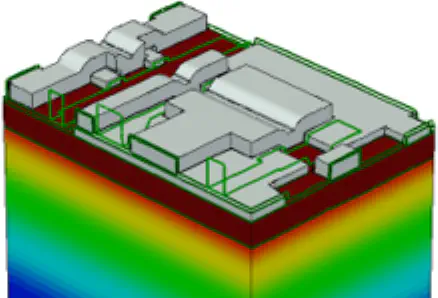
The “AI for Semiconductor Device Modeling” project is an ambitious endeavor that harnesses the power of artificial intelligence to revolutionize the field of semiconductor device design and analysis. The primary motivation behind this initiative is to overcome the increasing complexity and scalability challenges in semiconductor device modeling, which traditional computational methods struggle to address efficiently.
At the heart of this project is the application of advanced machine learning algorithms and data-driven approaches to model the behavior of semiconductor devices. These AI models are capable of analyzing vast datasets, derived from both experimental measurements and theoretical simulations, to predict device performance, optimize design parameters, and identify novel materials and structures for semiconductor fabrication.
One of the key achievements of this project has been the development of predictive models that significantly reduce the time and resources needed for device characterization and simulation. By leveraging AI, the project has enabled more accurate and rapid prototyping, leading to faster innovation cycles in semiconductor technology.
Looking forward, the project aims to integrate AI more deeply into the semiconductor manufacturing process, enhancing automation and precision in fabrication techniques. The ultimate goal is to establish a new paradigm in semiconductor design where AI-driven insights guide the development of more powerful, energy-efficient, and miniaturized electronic devices.
My recent publications in this field:
Z. Wang et al., “Improving Semiconductor Device Modeling for Electronic Design Automation by Machine Learning Techniques,” IEEE Trans. Electron Devices, pp. 1–9, 2023, doi: 10.1109/TED.2023.3307051.
Z. Wang, L. Li, and Y. Yao, “A machine learning-assisted model for GaN ohmic contacts regarding the fabrication processes,” IEEE Trans. Electron Devices, vol. 68, no. 5, pp. 2212–2219, May 2021, doi: 10.1109/TED.2021.3063213.

Zeheng Wang
CERC Fellow of Quantum Artificial Intelligence @CSIRO
My research interests include quantum machine learning, quantum computing devices, semiconductor devices, and applied artificial intelligence for electronics.